
The Mistake Most People Make First
The door won't lift, so the natural move is to hit the wall button again, then again, holding it down a little longer each time, or to grab the bottom edge and yank. It's tempting because it feels like the door is just 'stuck' and a little extra force should pop it loose — and sometimes it does. But that extra force is exactly what strips opener gears, bends a track, or snaps a cable that was already weakened by salt air. A door that's reluctant to move on a cool, damp morning is usually telling you something specific. Force treats the symptom and skips the diagnosis.
What You're Actually Seeing
In this part of Brevard County, 'frozen' rarely means ice. It means a door that behaves like it's frozen: it won't lift, it lifts a few inches and stops, the opener motor strains or clicks before reversing, or the bottom seal looks like it's peeling away from the concrete slab instead of sliding freely. You might also notice a faint scraping or grinding sound on the first run of the day that disappears by afternoon, or a thin film of moisture along the tracks that wasn't there the night before. These are the real-world versions of 'frozen to the ground' you get with Florida's humidity swings instead of hard freezes.
Cause #1: The Bottom Seal Is Stuck to the Slab
This is the first thing a technician checks because it's the most common and the easiest to misdiagnose as a motor problem. Overnight humidity drops the temperature of the concrete floor faster than the rubber astragal (the weatherstrip along the bottom of the door), and the two surfaces can bond slightly through condensation and surface tension — especially if the seal is older, flattened, or slightly cracked from sun and salt exposure. The fix is straightforward: gently break the seal by hand along its length rather than forcing the opener to do it, then check whether the astragal has gone stiff, split, or lost its shape. A seal in that condition should be replaced; it's a low-cost fix that also helps block wind-driven rain during storm season.
Cause #2: Track Obstruction or Misalignment
Next, a technician runs a hand along both tracks feeling for rust pitting, salt residue, or small debris that's built up in the channel. Coastal air accelerates corrosion on galvanized tracks faster than inland homes see, and a rough or slightly bent section of track creates drag that shows up as sluggishness before it becomes a full jam. The fix involves cleaning the track with a dry cloth (not WD-40, which attracts grit), checking the track-to-frame bolts for looseness, and using a level to confirm the track hasn't shifted. Minor misalignment can be tapped back into place; a bent section usually needs replacement.
Cause #3: Corroded Rollers and Hinges
If the door moves but feels heavy or grinds at certain points, the rollers and hinges are the next stop. Salt air works on the small moving parts of a garage door — the roller bearings and hinge pivots — long before it's visible on the panels themselves. A technician will spin each roller by hand to check for resistance or flat spots, and flex each hinge to feel for stiffness. Worn rollers get replaced rather than lubricated back into service, since a pitted bearing will keep seizing regardless of how much grease goes on it. This is a standard part of cable and roller replacement work.
Cause #4: Old or Washed-Out Lubrication
Lubricant that's been in place since spring often thickens with dust and salt residue, especially after a summer of afternoon downpours washing grit into the hardware. A light, dry-type lithium or silicone lubricant on rollers, hinges, and the torsion spring gets things moving freely again, but it's a maintenance step, not a repair — if lubrication alone fixes the problem, the door was close to needing attention anyway, and it's worth scheduling a full tune-up before the next cold snap.
Cause #5: Spring Tension Shifting with Temperature
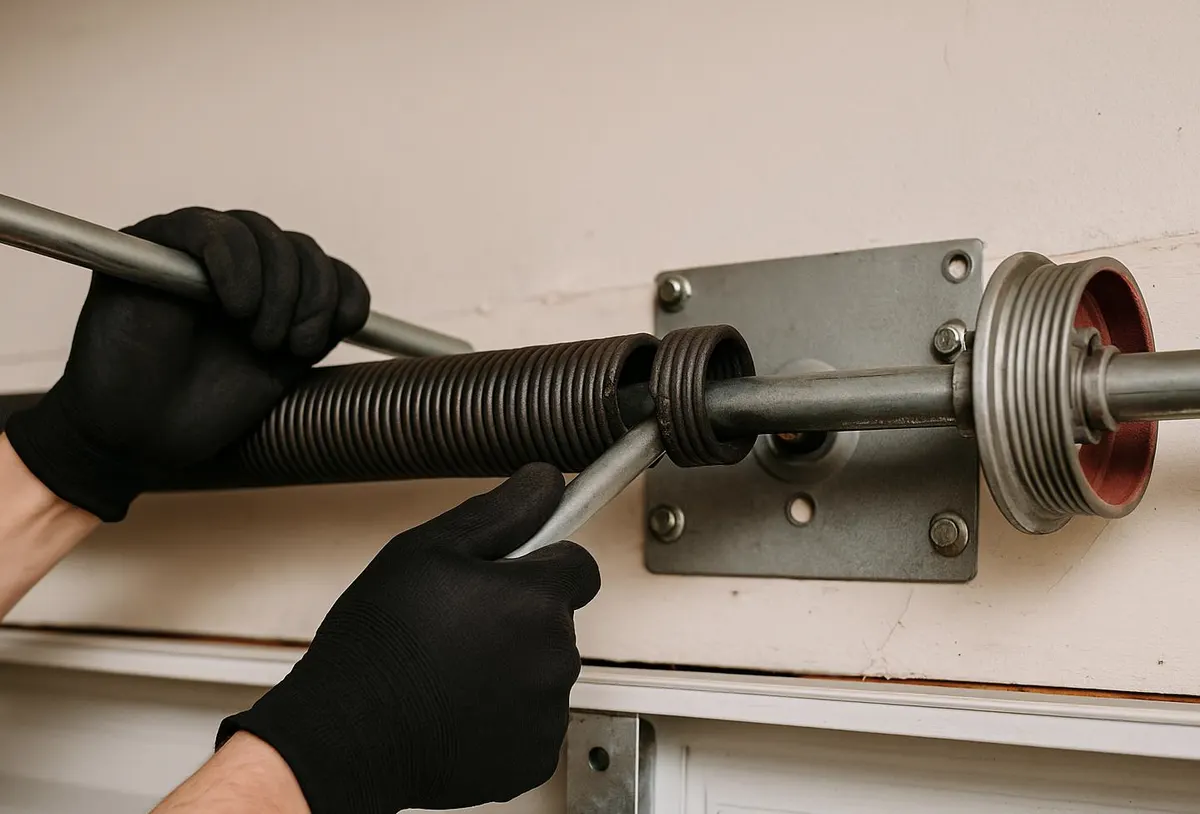
Metal torsion springs contract slightly in cooler air, which can make a door that was already near the end of its spring life feel noticeably heavier or harder to lift on a chilly morning. This is checked by disconnecting the opener and manually lifting the door halfway: it should stay in place on its own. If it drops or feels like dead weight, the spring is losing tension and temperature is just exposing a problem that was already building. Spring work should never be DIY — the tension involved can cause serious injury — and it's one of the few garage door issues where same-day attention matters, since a spring that fails mid-cycle can let the door fall.
Cause #6: Opener Force Settings Out of Calibration
Last on the list, because it's the easiest to adjust and the least likely root cause, is the opener's force and limit settings. If the door strains, reverses, or stops short consistently even after the mechanical issues above are ruled out, the force setting may be compensating for a heavier door than it was tuned for — often because of everything listed above adding friction over time. Recalibrating the opener is quick, but it should happen after the mechanical causes are addressed, not instead of them.
When to Call Indian Harbour Beach Garage Door Pro
If the bottom seal keeps sticking, a roller is visibly pitted, or the door drops instead of holding when you test it manually, it's time to call. We'll run through the same sequence above — seal, track, rollers and hinges, lubrication, spring tension, opener calibration — and handle whatever's actually causing the drag, whether that's a straightforward Garage Door Tune-Up and Maintenance visit or Cable and Roller Replacement for hardware that salt air has worn out. If the door is also running off its track or binding unevenly, our Off Track Door Repair service gets it back on line the same visit.
If your garage door is sluggish or sticking on these cooler Indian Harbour Beach mornings, call Indian Harbour Beach Garage Door Pro for a fast diagnosis and a fix that lasts past the next cold snap.