
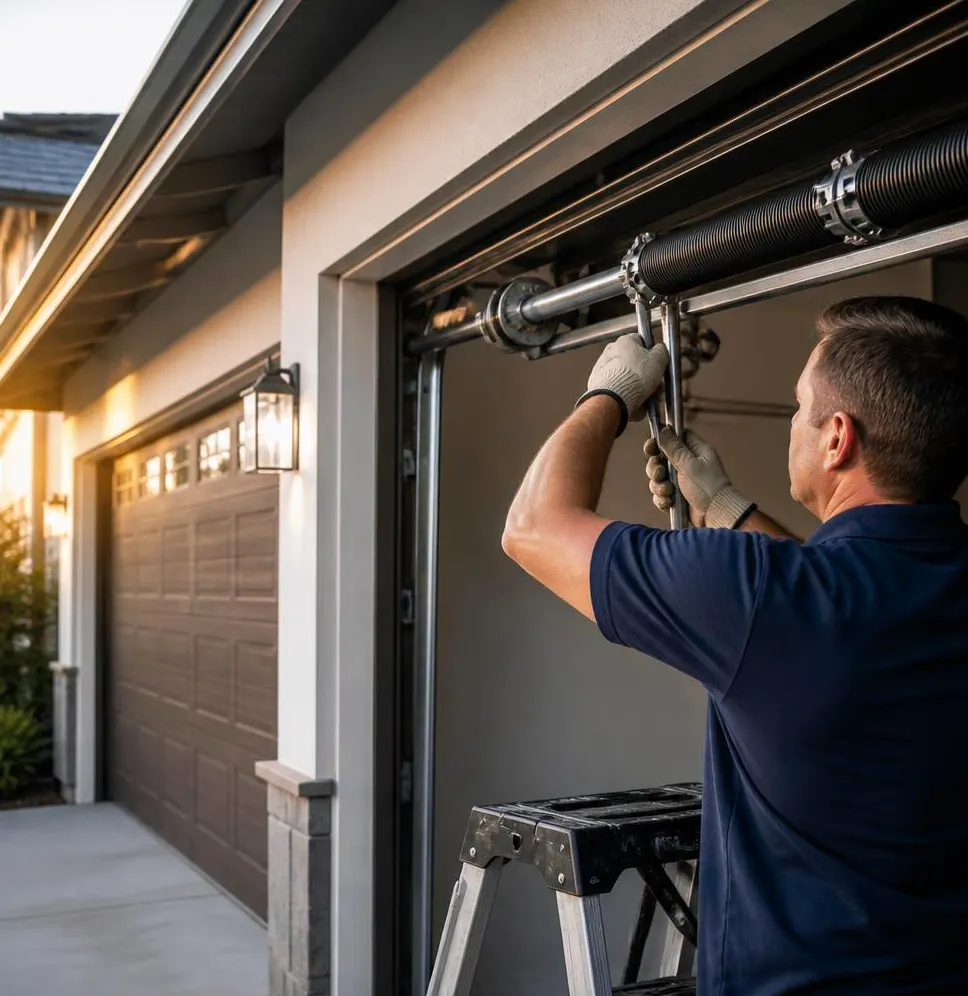
The Short Answer
You can usually spot a failing spring before it snaps: look for visible gaps between coils, rust or flaking on the metal, a door that hangs crooked, a heavier-than-normal lift, or a loud bang during opening or closing. Any one of these means the spring is losing tension and is close to the end of its life. Walk through the checklist below with the door closed and the opener disconnected, and you'll know within ten minutes whether you're dealing with a spring on borrowed time.
Before You Start: Disconnect the Opener
Pull the manual release cord so the opener motor isn't doing the lifting for you. You want to feel what the spring itself is doing, not what the motor is compensating for. This also matters because a weak spring forces the opener's gears to work harder, which is often how a $150 spring problem turns into a $400 opener repair.
The 9-Point Spring Checklist
- Gaps between coils on a torsion spring. Torsion springs sit on a bar above the door. Healthy coils sit tight against each other. If you see daylight between coils, especially near the center, the spring has lost tension and is stretching unevenly. This is one of the clearest pre-failure signs there is.
- Rust or flaking on the coils. Salt air off the coast speeds this up considerably compared to inland garages. Surface rust alone isn't an emergency, but rust that's pitting the metal or flaking off in flakes weakens the spring's structure and makes a sudden snap more likely, especially under the extra strain of storm winds.
- The door hangs crooked when you open it halfway. With two torsion springs, one can weaken faster than the other. If the door tilts to one side instead of staying level, one spring is carrying more load than it should.
- The door feels noticeably heavier to lift by hand. With the opener disconnected, a properly balanced door should lift with moderate, even effort and stay roughly where you leave it at waist height. If it feels like dead weight or drops on its own, the springs aren't doing their job anymore.
- A loud bang or pop during use. This is often the sound of a spring coil separating under stress, not a full break. Treat it as a final warning, not a one-time fluke.
- Frayed, loose, or rusted cables near the bottom brackets. On extension spring systems, the cables and springs work together. A fraying cable usually means the spring on that side has stretched further than it should, shifting load onto the cable.
- Visible stretching or elongation in an extension spring. Extension springs run along the horizontal tracks and should stay a consistent length when the door is closed. A spring that's clearly longer than its partner on the other side is losing elasticity.
- The opener grinds, stalls, or strains partway through the cycle. If the motor sounds like it's working much harder than it used to, especially on the way up, a weakening spring is likely transferring extra work onto the opener itself.
- The door closes faster than it used to, or slams. A healthy spring system controls the door's descent at an even pace. A door that drops quickly near the bottom has lost spring tension and is relying on gravity instead of counterbalance.
Why Local Weather Speeds This Up
Humidity and salt air are harder on exposed metal here than in drier inland climates, and that affects springs directly through rust and corrosion. Hurricane season adds another layer: homes built or retrofitted to wind-load standards often have heavier, reinforced doors, which means the springs are working against more weight every single cycle. A spring that's already showing wear going into storm season is more likely to fail during the exact weeks you need the door working reliably, during high winds or repeated opening and closing to move vehicles in and out.
What To Do If You Check Two or More Boxes
One warning sign is worth watching. Two or more means the spring is actively failing, not just aging normally. At that point, stop operating the door manually or by opener until it's inspected. Springs under tension are dangerous to handle without the right tools, and a spring that lets go while someone is reaching into the track area can cause serious injury.
When to Call Indian Harbour Beach Garage Door Pro
If you're seeing gaps in the coils, rust pitting, an uneven door, or a door that's suddenly heavy to lift, it's time to call us before the spring breaks on its own schedule instead of yours. We handle Garage Door Spring Repair for both torsion and extension systems, and if the extra strain has already worn down cables or rollers, we can address that in the same visit with Cable and Roller Replacement. We serve Indian Harbour Beach and nearby communities including Satellite Beach, Melbourne, and Eau Gallie, and we show up ready to diagnose the real problem, not just patch a symptom.
If your garage door is showing any of the signs above, call Indian Harbour Beach Garage Door Pro today and get it fixed before it fails on you.